

I have been asked to speak on “Building Resilient Fintech Products for Africa’s Dynamic Economy”, but here’s what I am going to do instead: I will share our story and experiences on building Cardtonic in this ever-changing economy, and I hope you can pick some practical lessons from our journey.
Our story is one of resilience, grit, dedication, doing it afraid, and surviving in this challenging terrain. Now, the downside of taking this route is that I run the risk of sharing sad and possibly embarrassing moments about our journey, because these are real stories that must be consistent.
So, Tomi, here, is going to help give me signals when she feels a story I am about to share is not ripe for public consumption, and generally be my anchor while I am on this stage. Tomi BTW is our growth lead and is doing an amazing job pushing our growth efforts. Is it fine if I ask you to appreciate Tomi and some other members of our team at Cardtonic? I never miss the opportunity to appreciate the humans of Cardtonic at every chance I get.
On February 5, 2021, the CBN released a circular ordering banks and other financial institutions to cease dealing with crypto exchanges, crypto-affiliated products, and to close associated accounts. I recall this day vividly because it was the beginning of a new month and a Friday, which is usually a busy day for us.
That Friday, rather than focusing on operations, five of us on the management team, including the founding CEO, who had rushed down to Nigeria upon hearing the news, sat in our small conference room analysing the circular and what it portends for our product, livelihood, and future.
Some months before this circular, yours truly had foolishly quit a relatively “stable” job because some two crazy guys that I had known from the university had sold a funny idea to me on how they were trying to build the next big thing that would change how international payments and purchases are made. While we were in the conference room that night, someone made a joke that well, some of us did attend university and graduated with flying colours so maybe we will go dust our papers and return to formal employment, a diss meant for the founding CEO who had dropped out of school because in his words, “he got tired of all the theories in his computer science course and could not wait to start building products”.
After the jokes and some other difficult deliberations, we resolved that we are all together on this ship, and we are going to do all it takes to ensure we don’t turn off the light on this dream. What followed this resolution was both gruelling and uncomfortable. Overnight, we pulled down the off-ramp crypto product initially embedded in the Cardtonic product, deployed a new web and mobile app, and by Monday, we were reaching out to existing providers and other new providers to allow us to use their rails to pay our customers. I had promised not to motivate anyone during the course of this talk directly, and that is why I am only sharing our journey. However, I will make an exception here to say, “Jokes on you if you allow anything whatsoever to kill your dreams or innovation.” Innovations are meant to be a new way of doing things, which people or even regulators could therefore misunderstand. Four years down the line, and crypto has now become the coolest kid on the block. Established brands are using stablecoins to facilitate payments, with millions of dollars raised in funding. Banks now use it as a legal means of exchange, and even governments are creating national digital currencies. As a result, almost everyone everywhere is now open to the idea of a digital currency.
Thankfully, we didn’t let our crypto off-ramp dream die in the moment; it has now become Breet, a fully independent product that is making crypto spendable in Nigeria and Ghana with its own independent management, team and corporate structure.
But I digress, back to our journey and how we navigated that phase, the next few days were gruelling as we had to manually process thousands of payment requests by our users who had also seen the news, did not know what to expect and were on red alert. But we had long resolved in the past that it would never happen that we would be unable to pay our users. While our payment rails shut the door on us, we had to find crude methods to pay users, including using personal accounts at some point. Today, we have one payment provider at every point in time trying to partner with us.
While that episode was one major challenge we faced, it does not capture all the different difficult moments and how we navigated the challenges. The Tech ecosystem in Africa is building momentum, but it was not always like this. I recall with nostalgia the early days when payments and collections felt like constant firefighting. Customers expected their money to be available; failed deposits resulted in support tickets and escalations with the service providers, who were not always available.
Days when customers were willing to drag you to hell because they had just requested 2,000 or some amount of money, and while the sum of money has been processed on your end, the user has yet to receive it, and regardless of your explanation about a downtime happening somewhere, you are at fault because you are the responsible party to the user.
I tell my friends building rails and infrastructures that they are lucky players in the ecosystem because the B2C is the real ghetto. While businesses are responsible, responsive to you and are always willing to cooperate with you, interfacing with users is another ball game altogether. Not to mention your obligations to regulators, partners and even app aggregators.
I could go on and on about the several challenges we have faced and how we have built resilient products in this challenging landscape, infact, these challenges no longer mean anything to us. We have learnt that before momentum is built, an object is typically moving at a certain velocity. To build momentum, a force needs to be applied to the object, causing it to accelerate and gain speed. The amount of momentum gained depends on the magnitude of the force, the duration of the force, and the mass of the object. At Cardtonic, we see all challenges as a force that accelerates the development of our product.
What started as a random discovery when the co-founder needed to buy make-up accessories for his then girlfriend - now wife and had to use a Sephora gift card because his Naira cards did not work has now grown to the super app facilitating cross-border payments and purchases with its virtual card, gift cards, international bills payments and other several alternative methods, servicing over 1.5 million users in Nigeria and Ghana without any external funding at least up on till now save for the initial 5 million in personal savings at inception.
We have done this because:
We did not give up on dreams,
stayed consistent in providing value over vanity marketing campaigns,
focused on revenue as fuel and discipline as our compass,
remained resilient because we wanted to build a company that exists regardless of external funding, not because of it.
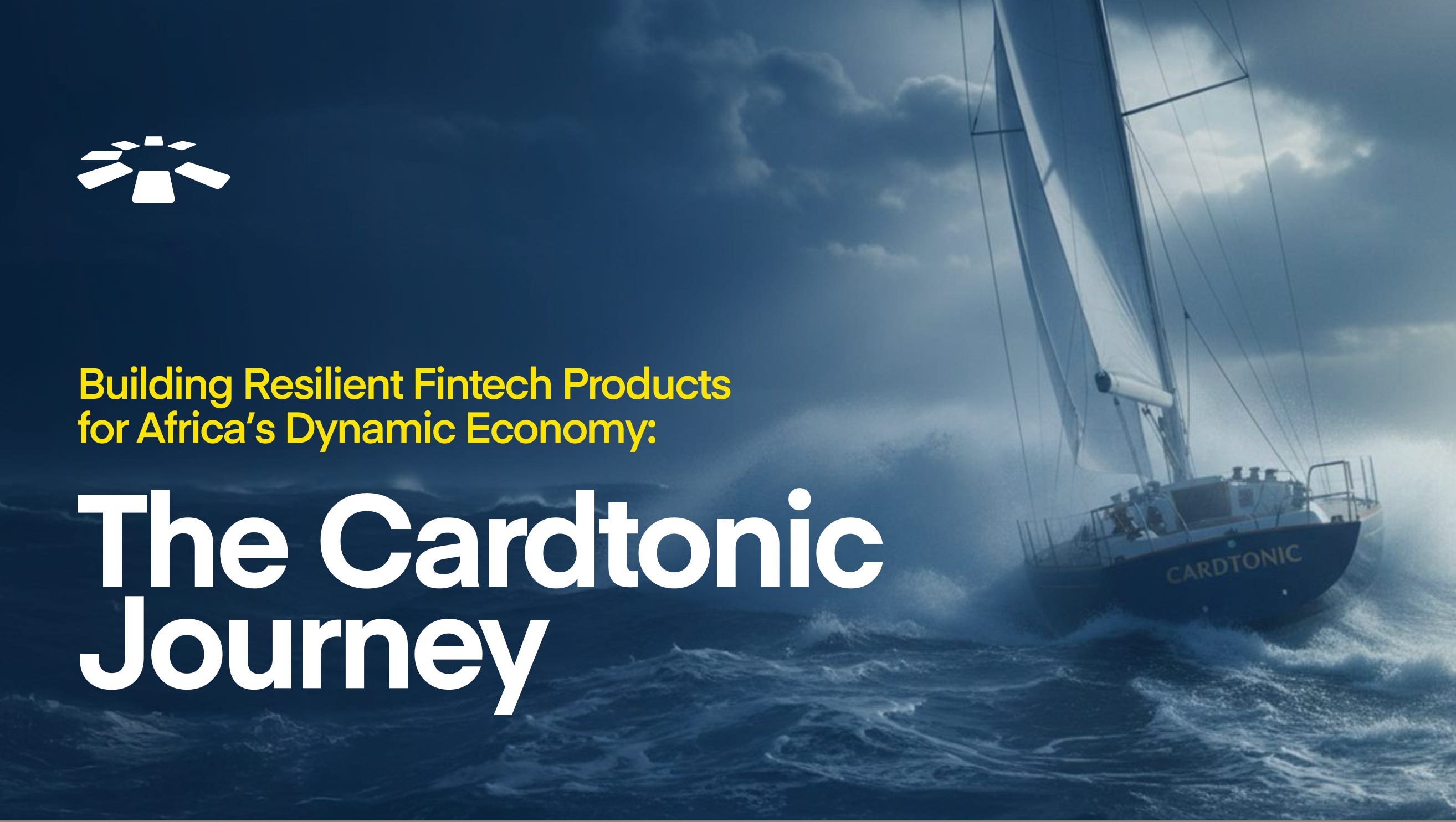
As I wound down, building resilient fintech products for Africa’s dynamic economy requires a deep understanding of the challenges and opportunities that come with it. At Cardtonic, we’ve learned that resilience is not just about weathering the storms, but about harnessing the power of challenges to build momentum. As we continue to innovate and push boundaries, we’re reminded that our journey is not just about building a fintech company, but about empowering millions of Africans to participate in the global economy. To all the innovators, entrepreneurs, and dreamers out there, we urge you to stay focused, stay consistent, and stay resilient. The future of Africa’s fintech industry is bright, and we’re excited to be part of it.
Thank you.
Your definition of resilience, ability to weather the storm and the effort your team had to put up to keep business running regardless of the odds stacked against the company is very astounding.
It's true that we sometimes need to take unconventional routes and do things that don't scale, but it's a bit scary when the regulatory policies are a threat in the market we aim to play. Not many survived that period in time.
Big ups to the team for being resilient. It's not easy to build African companies.